The Object Above My Garden Waited Until I Was Alone | Horror Story Animated
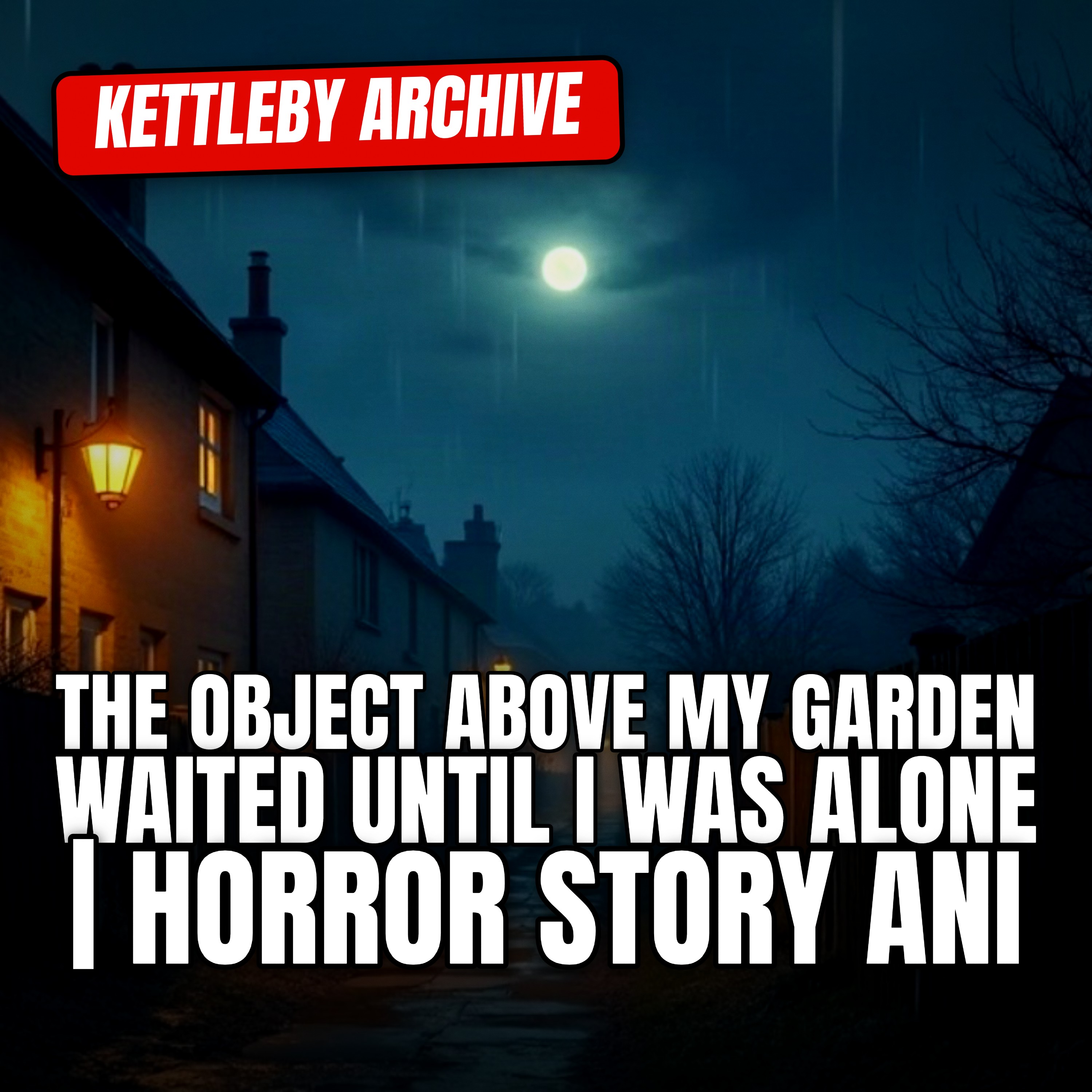
Do not go into the garden after the light goes, and do not let it see you looking. My mother wrote that. Underlined it twice. I was alone in her terrace sorting her things, and something pale and oval had already hung above the far wall for two nights without moving.
Chapters:
0:00 The Sky Watched Back
1:48 The Photo That Failed
3:40 Nora's Underlined Rule
5:24 Nora's Voicemail
6:57 Something Breathing at the End
8:47 The Handle Turns
10:28 Morning, Two Coffees
12:12 The Figure in the Footage
Written and narrated by Alice Kettleby.
Original fiction — names, places and events are invented.
Chapters
- The Sky Watched Back
- The Photo That Failed
- Nora's Underlined Rule
- Nora's Voicemail
- Something Breathing at the End
- The Handle Turns
- Morning, Two Coffees
- The Figure in the Footage
Read the story
Do not go into the garden after the light goes, and do not let it see you looking. My mother wrote that. Underlined it twice. I was alone in her terrace sorting her things, and something pale and oval had already hung above the far wall for two nights without moving. I found the diary on the third evening.
By then I had already looked through her binoculars. By then it was no longer above the wall. Nora had hung a wind chime on the back door that rang at the smallest breath. Nora had called me every week for six months before she died. I stopped answering. I was angry about something I cannot even properly explain now, something small and stupid, and I let it sit.
So now I was in her reading chair surrounded by her handwriting, and it was the only place I could think to be. At eleven on the second night I went out to drag the bins round front. I stopped dead at the back step. Above the far wall, pale and perfectly still, was an oval shape roughly the width of my arm span.
It caught the orange from the streetlamps beyond. It did not move. Back inside I picked up the binoculars. The strap was still warm, which made no sense, the kitchen had been cold since Tuesday. I raised them toward the window. The object filled both lenses immediately, far closer than it should have been.
Why had it moved without me watching? I wrote: weather balloon. Drone. I looked at the photo again. That dark centre, symmetrical, deliberate, was not heat on glass. I deleted it immediately and wished I hadn't. As I turned from the window, the wind chime behind me gave one long note.
No window was open. Next morning I checked before I put the kettle on. Still there, same pale oval, broad daylight, same position. Then the wind chime rang. Once. Long. I stepped onto the back step and held my hand out flat. Not a breath of air moved against my palm. Suki arrived at half ten.
By eleven she'd found the diary. I showed her the object and she read from her phone: 'Three balloon releases, Coldham Street, last Saturday. ' Then she looked again, harder. 'Dell,' she said slowly, 'balloons don't hold still for four days.' Suki's landlord rang at half three. She had to leave.
What I couldn't answer then, and still can't, is why neither of us said goodbye properly. I came back to the kitchen. The window where she'd stood was fogged, a single handprint on the glass. Only one. Mine was on the door. That evening I picked up Nora's binoculars and looked. The object was closer, rooftop height now, above the garden itself.
Through the lenses the underside was textured, irregular, like something pulled tight over a frame. I set them on the table. The clock on the cooker read 22:07. Then it went dark. There was a drawer beneath where Nora kept the binoculars. Inside I found a slim diary. I flipped to the last written page.
One sentence, underlined twice, in Nora's neat hand: 'Do not go into the garden after the light goes, and do not let it see you looking. ' PC Vell was calm. The calmness was the problem. He said balloons drift, asked if I'd eaten. Then, from the back garden, the wind chime rang once through the closed kitchen door.
Vell didn't react. He wrote something, capped his pen, and said he'd see himself out. I should have rung Suki. It was 00:47, forty-seven minutes past midnight, and I had been staring at the same page of Nora's diary for twenty minutes without reading it. Twenty-two years old. I was not going to ring about a balloon.
Then the landline rang first. I propped my phone against the mug, hit record, went to bed. Sometime after three I heard the wind chime, one clear note, then silence. By morning the footage showed forty minutes of dark garden, then a long white flare that wiped the frame. Nothing after that.
Nothing at all. Two days passed. Third morning, sky empty. I walked the full length to the stone wall, no cord, no mark. I laughed, short and embarrassed, and turned back toward the house. Then I stopped walking. From somewhere above the roofline came a sound: a slow, low hum, already closer than before.
Then I found the voicemail on Nora's old landline. Date-stamped three weeks before she died. Her voice: quiet, measured. She said it had come back, right above the bird table. She said she had not gone out. She said she thought it knew when the house was empty. Then the message ended.
A memory surfaced. Summer evening, ten years back. Nora pointing past the roof. I couldn't hear her over the lawnmower and I didn't look. Then I remembered something else, tucked in the diary's back cover, a folded paper I hadn't opened. It was dated the same summer. Nora's handwriting: 'It came back.
Don't look up.' I was eating beans on toast at nine that evening when the wind chime rang. Not once. Steadily. Every four seconds, like something keeping time. I looked up from my plate. The object was back. Level with the upstairs window. It filled the glass completely. It had not been there a moment before.
I ran upstairs to see it clearly. The bedroom was dark and the object filled the whole pane, right there, close enough that I should have been able to see texture. I turned on the light to find my phone. When I looked back the window was empty. My phone had no signal. Then I heard it.
From the far end of the garden, through the closed window, a low rhythmic sound. Not mechanical. More like breathing, measured out at long slow intervals, each one the same length. Faint enough to doubt. I told myself it was the boiler next door. I almost believed it. I checked every window.
I made myself go to the rear bedroom, the one that looked back over the garden. The object was lower now, hovering over the bird table in the middle of the garden. And below it, on the grass, was a dark shape. Roughly the size and posture of a crouching person. I had not locked the back door when I ran upstairs.
I realised this standing in Nora's bedroom with my hand on the cold window latch. I thought about going down. I thought about the shape on the grass. I stood there for what I think was three full minutes and I did not move. Nineteen percent battery. No signal. I picked up the landline and heard a tone I didn't recognise, a triple pulse, repeating.
I opened Nora's kitchen drawer for her emergency torch. Corroded. Dead. Then the triple pulse stopped, and the line went absolutely, completely silent, and something downstairs moved. The sound was on the stairs. Slow. Evenly spaced. Closer. I backed into the kitchen, closed the door, gripped the handle with both hands.
I told myself old houses breathe. I told myself that. Outside the window, the object sat level with the roofline, and it had not moved in seventeen minutes. At 2:14 a.m. the handle turned. Patient. No forcing. Then one syllable through the wood, Dell, spoken in a voice that knew me.
Three seconds later I had the landline stretched to my hand, shoulder burning, and I was telling Suki: someone is inside, ring 999, I cannot let go. I am holding the handle. It is still turning. The wind chime across the room begins to ring. No window is open. I have not moved. Whatever is on the other side is not pushing.
It is simply waiting to see when I will stop. I reached the landline on the counter without letting go of the handle, stretched until my shoulder burned. I dialled Suki's number from memory. When she answered I said, very clearly, there is someone inside, ring 999 for me, I cannot let go of this door.
She understood. The pressure on the handle stopped at 2:31 a.m. Police arrived seventeen minutes later. PC Vell walked the garden with a torch. He found nothing. Except the bird table had been moved six feet closer to the house than I knew it was. Nobody commented on that. PC Vell told me the lock showed no sign of force.
He said I was overtired and grieving and had probably heard the house. I did not argue. But as he left he paused at the garden gate and looked up. His face went very still. Then he got in the car. Seven-oh-four a.m. Suki set two coffees down. We did not speak for a full minute. Then I noticed the binoculars on the floor, three metres from the windowsill where I had left them.
Neither of us had moved them. Neither of us mentioned it. Who had? Inside the binocular case, tucked into the felt lining, was a small card in Nora's handwriting. It said: 'It listens for one voice at a time. When you are the only one here, you are the one it practises. ' That was everything.
That was the whole card. The memory from the lawnmower evening finally sharpened. I could hear her now. Nora was saying, don't look up at it directly, and never be alone in the garden at dusk. She had said it once. I had not heard it. She never said it again. Suki told me what the 999 operator had said when she called the night before.
The operator had mentioned it unprompted, three other calls from the same street over the past eighteen months. All of them from people staying alone in a house where someone had recently died. The operator had said it like a footnote. Suki had not forgotten it. I found a voicemail on my own phone I had never recorded, my voice, saying: 'Four percent.
Last bar. It knows. ' I have no memory of leaving it. My battery that night bottomed at three percent. I sold the house. I have not stood alone in a garden after dark since. Not once. There is one thing I left out. In the forty minutes of garden footage, before the white flare, there is a figure at the far end near the stone wall.
Completely still. Facing the house. It is wearing a floral housecoat. I have not found a way to explain that. Before I handed over the keys I played Nora's voicemail one last time. At the end, after she stops speaking, there is a second voice. Faint, low, evenly spaced. It is saying my name.
And from the sound of it, from how worn it is, it has been saying it for a long time.
This story is fiction: names, places and events are invented.
A free book
Eight Kettleby Archive files as a free book, one of them never told anywhere else, and the Horror Club by email.
Get it →The horror books
Alice Kettleby's books, sold directly by the press that publishes them.
Browse →The Kettleby Archive: The First Files. Eight files as a PDF and EPUB, one never told anywhere else. The link comes by email.