The Policeman Who Lost Fifteen Minutes: The Todmorden Case (Real Case)
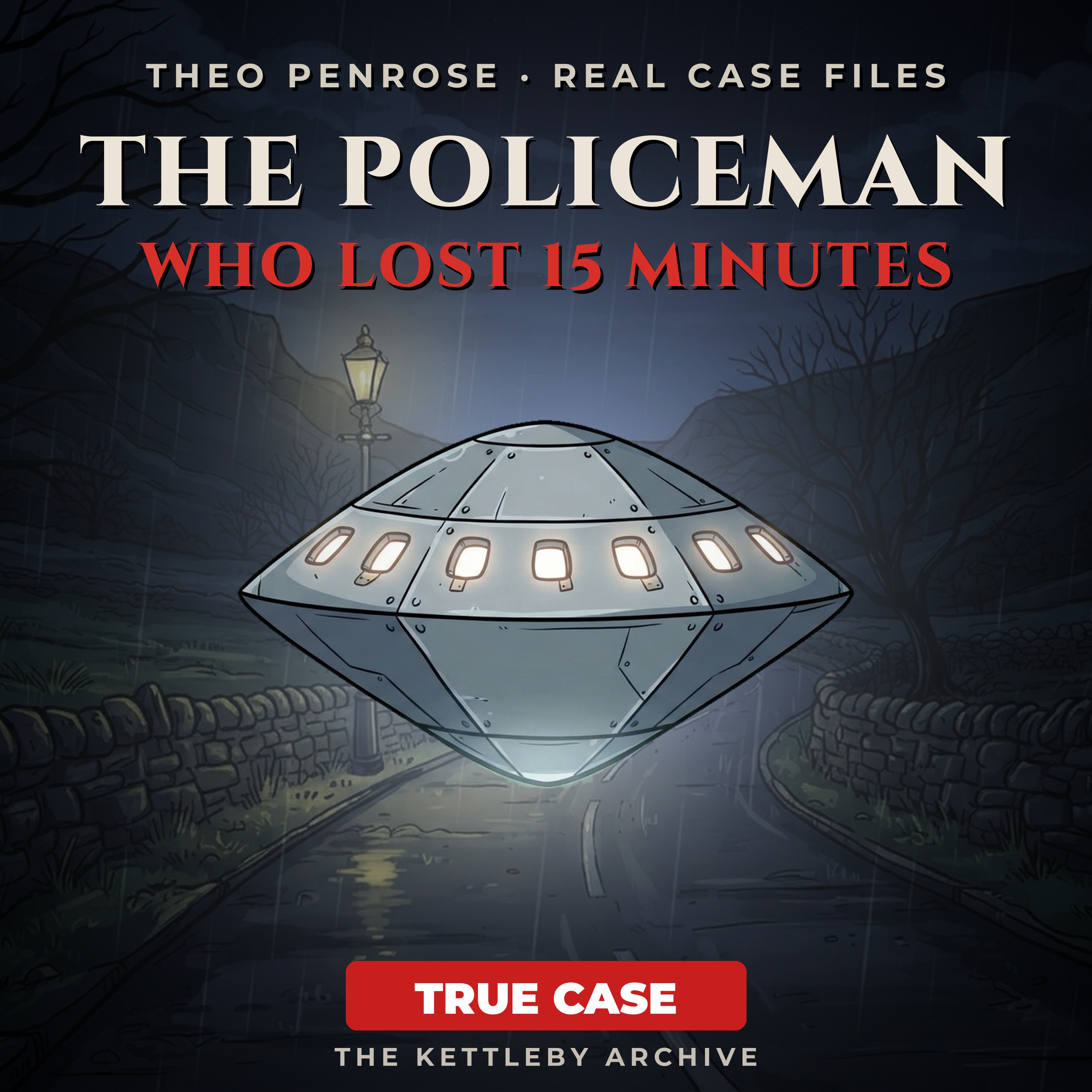
There was a light waiting in the road, in the rain, in the dark before dawn. The police constable watching it reached for his radio, and the radio was dead.
Todmorden, West Yorkshire, November 1980. PC Alan Godfrey is out on Burnley Road looking for loose cows when he finds something hovering above the tarmac. He draws it in his notebook. Then a burst of light, and part of that night is gone. Theo Penrose opens the case: the man on the coal heap five months earlier, the dry patch, the split boot, the other witnesses that morning, the hypnosis, the price Godfrey paid, and the doubts.
This is a real case, retold from Alan Godfrey's accounts, Jenny Randles's published investigation and later interviews. Everything about the room and the figures comes from hypnosis, not from his waking memory. Narration by an AI voice.
📖 The book, Missing Time, Volume Two: The European Files (chapter eight): https://louloubooks.com/shop/missing-time-volume-two?ref=pod-todmorden
▶️ Watch the animated version on YouTube: WTF Scary Stories
Sources:
Jenny Randles, The Alan Godfrey abduction: https://ufologie.patrickgross.org/htm/godfrey80.htm
Alan Godfrey (overview): https://en.wikipedia.org/wiki/Alan_Godfrey
History UK, The Todmorden UFO mystery: https://www.history.co.uk/articles/the-todmorden-ufo-mystery-a-close-encounter-in-west-yorkshire
© 2026 Lou Lou Press. All rights reserved.
Chapters
- The light in the road
- November 1980
- Todmorden
- The man on the coal heap
- Looking for cows
- The light on Burnley Road
- He drew it
- The lost minutes
- The dry patch and the boot
- Not alone that morning
- The investigation
- Under hypnosis
- The price
- The doubts
- What the doubts cannot cover
- A dream, or something else?
Read the story
There was a light waiting in the road ahead of him, in the rain, in the dark before dawn, and it was the wrong kind of light. It was spinning. And the bushes on both sides of the road were shaking. The thing in the road was not touching the ground. The police constable watching it reached for his radio, and the radio was dead.
That was the end of November, nineteen eighty, on a wet road just outside a mill town in the north of England. His name is Alan Godfrey. And it was the second thing he could not explain that year. Five months earlier, he had been one of the officers called to a dead man, lying on top of a heap of coal.
What happened on that road cost Alan Godfrey his career. And decades later, he said one thing about it that changes how you hear every part of this story. I will tell you what it was when we reach the doubts. Todmorden sits right on the border of Yorkshire and Lancashire. A mill town in a deep valley, with a canal, a railway viaduct, steep moors on every side, and Burnley Road running out along the valley floor.
If you have ever driven that road out of town in the dark, you know how black that valley gets. Tell me in the comments. In nineteen eighty, Alan Godfrey was thirty three, a constable with West Yorkshire Police, working in the town. On the sixth of June that year, a fifty six year old coal miner called Zygmunt Adamski left his home in Tingley, about twenty miles away, to go to the shops.
He never came home. Days later, his body was found on top of a pile of coal about ten feet high, in a coal yard in Todmorden. He was wearing his suit, but his shirt was gone, and so were his wallet and his watch. His hair looked roughly cut. He had been missing for days, yet he had only one day's growth of beard.
And according to the coroner, James Turnbull, there were burns on his head, his neck and his shoulders, and some of them had been treated with an ointment the forensic scientists could not identify. Alan Godfrey said later that the man looked as if he had been frightened to death. So who treats the burns of a man who has vanished on his way to the shops? Nobody has ever answered that.
Where Zygmunt Adamski was for those days, and how he came to be lying on top of that coal, is still unexplained. Five months later, at the end of November, in the dark before dawn, Godfrey was sent out on the most ordinary job a constable can get. Some cows had got loose on a housing estate, and somebody had to find them. So he drove out slowly along Burnley Road, headlights on the wet tarmac, looking for cows.
Ahead of him, in the road, there was a bright light. As he got closer, the light became a shape. By his own description it was about twenty feet high and fourteen feet wide, shaped like a diamond, with a dome on top and a row of what looked like windows. It was hovering a few feet above the tarmac.
He reached for his radio. That is the moment this story began. So he did the one thing he still could. He propped his notebook against the windscreen and drew what was in front of him. Then came a burst of light. And Alan Godfrey was still sitting in his car, but further down Burnley Road than he had been a moment before.
The object was gone. And when he checked the time, it was later than it should have been. The accounts disagree about how much later. The investigators who worked it out at the spot put the gap at no more than fifteen minutes. Later accounts say twenty five minutes, or half an hour.
Either way, the only clock that measured it was his own reckoning. Remember that word, reckoning. It comes back. If you looked at your watch on an empty road and a quarter of an hour had gone, would you report it? Godfrey turned the car round and drove back to the spot. It had rained all night, and Burnley Road was soaking wet.
Except, he said, for one patch, right where the object had been hovering. There the tarmac was dry, in a swirled pattern. Later he found that one of his police boots was split along the sole, as if he had been dragged. And there was an itching red mark on his foot that had not been there before.
The cows turned up after sunrise. According to Jenny Randles, the UFO researcher who wrote up the case in nineteen eighty one, they were standing in a rain soaked field with no hoof marks around them. Godfrey made his report. And then he found out he was not alone that morning. Randles records that a driver at Cliviger, three miles further out, reported a brilliant white object at about the same time.
And a police patrol from Halifax, up on the moors watching for stolen motorbikes, had seen a blue white glow coming down towards Todmorden shortly before. The next week the story was in the local paper, and a UFO research group from Manchester began a long investigation. If real cases told straight, with the doubts left in, are what you want, subscribe, because there are more of them coming. And if you want this one with every source, it is chapter eight of my book, Missing Time, Volume Two: The European Files.
The link is under this video. About eight months after the night on the road, Godfrey agreed to be hypnotised by a psychiatrist in Manchester. Later he had more sessions with other therapists, and some of them were filmed. Everything in this part comes from those sessions. None of it is from his waking memory.
Under hypnosis, he described a beam of light that blinded him. Then a room, and a table he was lying on. There was a tall man with a heavy beard, in clothes that looked like something from the Bible, who let him know, without speaking, that his name was Joseph. There were small figures about the size of a five year old boy, which he said were like robots, with heads shaped like lamps.
And there was a large black dog. That story went further than Alan Godfrey ever wanted it to. A national paper put him on its front page. He was called in before his superiors and sent for a medical, which found him fit. Godfrey says he was driven out of the police because he would not drop his story.
Randles writes that, years later, he resigned over an injury he got while stopping a crime. Those are the two accounts, and they do not agree. What both accounts agree on is that the night on Burnley Road was the end of the life he had before it. Now the doubts. And the first one is the thing I promised you at the start, because it comes from Alan Godfrey himself.
Doubt number one. In twenty eighteen, he said the abduction that came out under hypnosis was probably a dream. He said he had never claimed he was abducted by aliens. And hypnosis does not play back a memory like a tape. Research going back decades shows it can make a person more sure of a memory without making it more accurate.
Doubt number two. Remember the word reckoning. The only measure of the missing time is one man's sense of how long a drive should take, at five in the morning, after a night on duty, on a dull job looking for cows. A quarter of an hour can slip away from anyone like that. Doubt number three.
The dry patch was seen by Godfrey alone. Nobody measured it, and nobody photographed it. Doubt number four. The coal heap. It is very tempting to tie the two stories together. The same town, the same year, the same policeman. Godfrey himself has said he keeps an open mind about Adamski.
But there is no evidence at all that links that death to the thing on the road. An unexplained death is not the same as a death explained by something from the sky. So here is what the doubts cover. A dream covers the room, the bearded man, the small figures and the dog. A tired mind covers the lost minutes.
But none of them covers the white light seen from Cliviger, the glow seen by the Halifax patrol, or the drawing Godfrey made while the thing was still in front of him. After more than forty years, that is the part he has never taken back. A shape spinning above the wet tarmac. A radio that would not answer.
A notebook propped against the windscreen. So which was it on Burnley Road, a tired man's dream, or something that nobody has ever identified? Alan Godfrey later wrote a book of his own. And one of the cases in it was not his. It was a young logger in Arizona who vanished in front of his whole work crew, and was gone for five days.
That case is right there on your screen.
This story is fiction: names, places and events are invented.
A free book
Listened to the cases? These are the files the archive couldn't verify: eight of them, free, one never told anywhere else.
Open the files →The horror books
Alice Kettleby's books, sold directly by the press that publishes them.
Browse →More episodes
43. 3 Real Alien Abductions: Allagash, Mojave and Kelly Cahill (True Cases)42. Her Dog Knew Something Was in the Yard: The Copley Woods Case (Real Case)41. It Came Through the Closed Door: The Andreasson Affair (Real Case)40. They Flashed a Light at It: The Allagash Abduction (Real Case)The Kettleby Archive: The First Files. Eight files as a PDF and EPUB, one never told anywhere else. The link comes by email.