They Flashed a Light at It: The Allagash Abduction (Real Case)
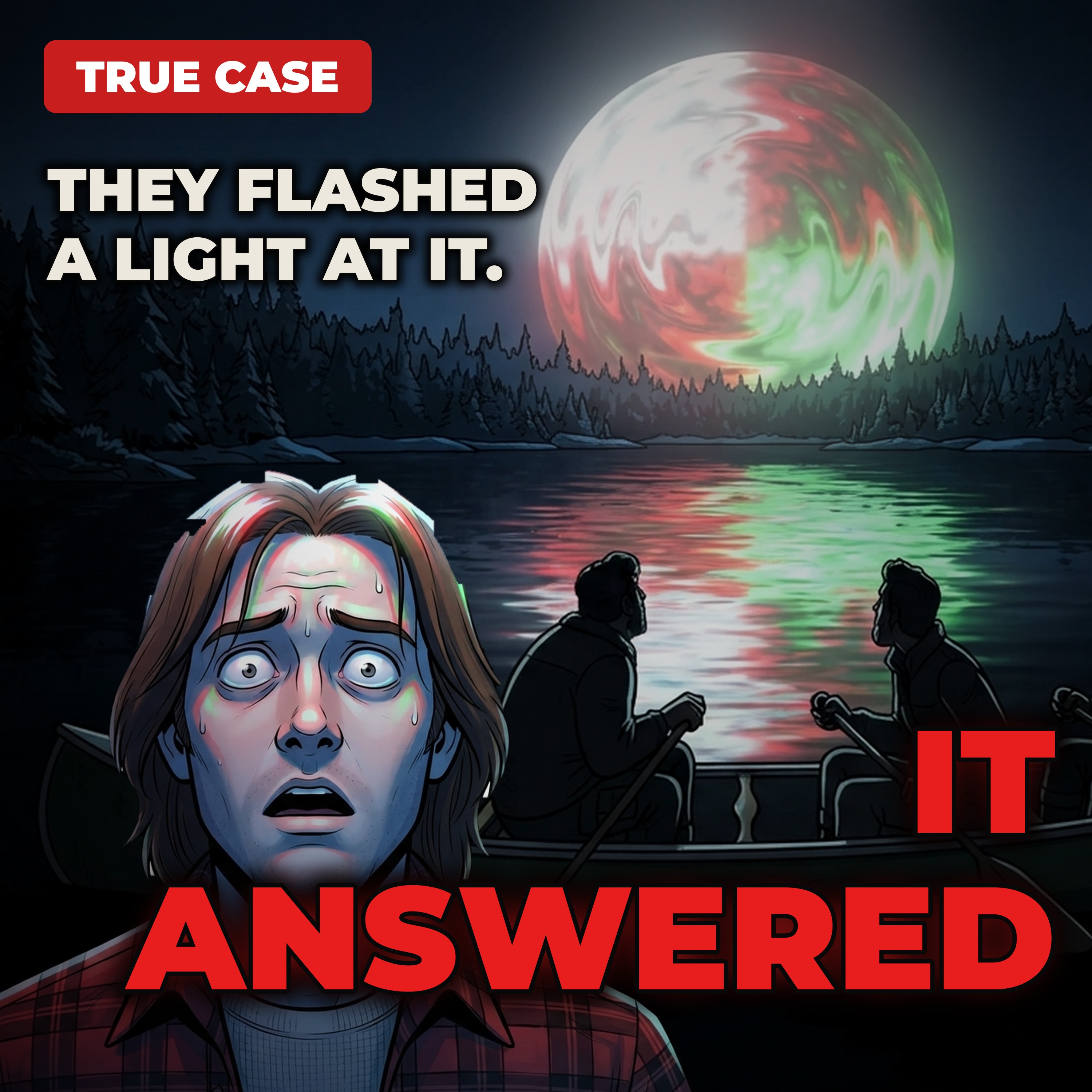
Four men in a canoe on a black lake in the Maine woods, a silent ball of boiling light over the trees, and a bonfire that burned down to coals in what felt like fifteen minutes. Theo Penrose opens the 1976 Allagash case, the catch, and every doubt the sceptics raise.
Chapters
- The dark on the lake
- Case file: the Allagash
- The four
- Eagle Lake
- The sphere
- The flashlight
- The beam
- Memories disagree
- The fire
- Then one of them fell
- Raymond Fowler
- The investigation
- Under hypnosis
- The twins
- The catch
- The doubts
- Where each doubt stops
- Eagle Lake tonight
- Next: Travis Walton
Read the story
There is a kind of dark you only find on a lake in the deep woods, a dark so thick you can't see your own hands on the paddle, and one night in northern Maine, four young men sat out in the middle of it and felt something looking back. Above the trees, something is rising. A huge ball of light, silent, its colours turning and boiling like something alive. One of them picks up a flashlight.
And he flashes it at the light. And the light answers. It stops. And it starts to come towards them. A beam drops out of it and hits the water. Then it begins to sweep across the lake, towards the canoe. They paddle for the shore, as hard as they can, towards the bonfire they built to guide them home.
Remember that fire. Because when they finally stepped out of that canoe, the fire they had built to burn for hours was nothing but red coals. And to them, it had felt like fifteen minutes. But this case has a catch. I'll tell you what it is later. For now, just remember that there is one.
Case file. The Allagash Wilderness Waterway. Northern Maine. Up near the Canadian border, the Allagash is a chain of lakes and rivers that runs for nearly a hundred miles through the forest. No towns. Hardly a road. Just spruce and fir, loons, and moose wading in the shallows. If you've ever paddled the Allagash, or camped on Eagle Lake, tell me in the comments what the nights out there are like.
In August 1976, four young men set out to paddle it. They were art students from Boston, at the Massachusetts College of Art, all in their early twenties. Jack and Jim Weiner, identical twins. Charlie Foltz. And Chuck Rak. A floatplane carried them and their canoes into Telos Lake, and from there they paddled north, camping on the shores as they went.
Chuck Rak has said they saw something strange two nights before, over Chamberlain Lake. A light in the sky. They didn't think much of it. On the twenty-sixth of August, they reached Eagle Lake and set up camp. That night they were hungry, so they decided to go out in one canoe and fish for trout in the dark.
To find their way back, they built a bonfire on the shore. A big one. Big enough, they said, to burn for two or three hours. Then the four of them paddled out onto the lake. It was very dark. And very, very quiet. And Chuck felt it first. The feeling that someone was watching him.
He turned around. Above the trees on the far side of the cove, two or three hundred feet up, there was a sphere of light. Huge. Bright. Completely silent. And not moving at all. He told the others to look. As they watched, its colours kept shifting, white, then red, then green, rolling over each other the way a sauce moves when it boils.
Charlie Foltz picked up the flashlight and flashed it at the thing. On, off. On, off. And the light stopped what it was doing. And began to come towards them. Would you have flashed that light? Tell me in the comments. A beam came out of the bottom of it. A hollow tube of light, they said, and where it touched the lake it made a glowing ring with a dark centre.
The beam began to move across the water. Towards the canoe. They grabbed the paddles and dug in, straight for the bonfire on the shore. And the beam caught up with them. It swallowed the canoe, and the four men in it. What happened next is where their memories begin to disagree. Charlie remembered reaching the shore and watching the light leave.
Chuck remembered sitting in the canoe, staring up at it, unable to look away. The twins remembered the thing hanging silently over the water, twenty or thirty feet up, for several minutes, before its beam swung up and it shot away into the stars. But they all remember the fire. They had been gone, they felt, fifteen or twenty minutes at most.
The bonfire they had built to last for hours had burned right down to coals. They sat on the shore and tried to make sense of it. Then they went to bed, finished the trip, and went home to Boston. For years, they hardly talked about it. Then one of them fell. Years later, Jim Weiner suffered a serious head injury.
Afterwards he developed a form of epilepsy. And at night, he began to experience things he couldn't explain. He told his doctors about figures at his bedside. About being unable to move. About feeling himself lifted from the bed. His doctors asked him to keep a record. And they suggested he talk to someone who studied these reports.
So he went to a lecture by a UFO researcher named Raymond Fowler. And afterwards, he told Fowler about the night on Eagle Lake. If you had kept quiet about something like that for twelve years, would you finally tell? Tell me. In January 1989, Fowler opened a formal investigation, with a physicist named David Webb and a hypnotist named Tony Constantino.
It ran for two years. Background checks. Medical records. Psychological tests. And hypnosis. Session after session, each man taken back, one at a time, to the night on the lake. Under hypnosis, the twins and Charlie Foltz described the beam lifting them out of the canoe. They described waking inside a craft, and small beings with big heads and large dark eyes.
They described being told to undress, and sitting on a bench under a white, diffuse light, unable to resist. They described a thin rod with a light on its tip, looking into their eyes and their mouths. They described being laid on a table, while instruments came down over their bodies, and samples were taken. And then the beam again, lowering them back into the canoe, which had drifted into the shallows near the camp.
And the fire was already coals. The twins went further. Under hypnosis, they said the visits hadn't started on that lake. That something had come to their bedrooms since they were children. In 1993, Fowler published the investigation as a book, The Allagash Abductions. The four men went on television, and on the series Unsolved Mysteries.
That is what these files are for. A real case, the whole record, and every doubt left in. If you want to be here when the next file opens, subscribe. Four men. One lake. And three of them, under hypnosis, describing the same craft. And that is where the catch comes in. Because one of the four now says it never happened.
In 2016, Chuck Rak told a Maine newspaper that there was no abduction. He said he had gone along with the story because he hoped it would make them money. He doesn't call it a hoax. He calls it brilliant storytelling. The other three still stand by it. Jim Weiner called Rak's claims the rantings of an angry and resentful man.
They say he fell out with them years ago, and changed his story after that. So now you have the catch. Here are the doubts, and they are serious ones. First, time. Thirteen years passed between the night on the lake and the first hypnosis session. The missing time was remembered, talked about, and pieced together long after the fact.
Second, hypnosis. Almost everything that happened inside the craft comes from those sessions. Researchers have warned for decades that hypnosis can leave a person more confident, without making them more accurate, and that what comes back can be shaped by suggestion. And by 1989, the abduction story, the bench, the exam, the samples, was already well known.
Third, Jim's illness. The case came back to life because of his visions at night, after a head injury and a form of epilepsy that can bring on exactly those kinds of experiences. Sceptics say the story grew from there. Fourth, remember that fire. Chuck Rak says the logs were only about three inches thick, and burned off fast.
Charlie Foltz says some of them were as thick as his leg. Two men who were there, and they can't agree on the firewood. Fifth, the man in the canoe who walked away. Rak says they had been smoking hashish that night. Foltz says there were no drugs, and only a few beers on the whole trip.
Every one of those is fair. But notice where each one stops. Hypnosis could have shaped the craft and the exam. It doesn't explain the light. All four men saw that, awake, from the canoe. Jim's illness came years later, and it was his alone. It can't explain what the other three saw over the water.
The firewood argument cuts both ways. Thin logs or thick ones, it tells us how fast a fire burns, not what was over the lake. And Chuck Rak, the one who walked away, has never said the light wasn't there. He still describes a huge, bright globe changing colour over the trees. But be honest about what the rest of it rests on.
The light rests on four men who were there. The abduction rests on three of them, under hypnosis, thirteen years later. So who do you believe? The three who still stand by it? Or the one who says it was only a story? The Allagash is still out there. You can paddle to Eagle Lake tonight, build your fire on the shore, and push out into the dark.
And somewhere above the trees, a long time ago, something answered a flashlight. So what did it see? Less than a year earlier, in a forest in Arizona, a crew of young men saw a glowing craft hanging over a clearing. One of them walked towards it, and a beam threw him to the ground.
This story is fiction: names, places and events are invented.
A free book
Listened to the cases? These are the files the archive couldn't verify: eight of them, free, one never told anywhere else.
Open the files →The horror books
Alice Kettleby's books, sold directly by the press that publishes them.
Browse →More episodes
44. The Policeman Who Lost Fifteen Minutes: The Todmorden Case (Real Case)43. 3 Real Alien Abductions: Allagash, Mojave and Kelly Cahill (True Cases)42. Her Dog Knew Something Was in the Yard: The Copley Woods Case (Real Case)41. It Came Through the Closed Door: The Andreasson Affair (Real Case)The Kettleby Archive: The First Files. Eight files as a PDF and EPUB, one never told anywhere else. The link comes by email.