They Had No Faces: Gary Wilcox and the Visitors Who Wanted Fertilizer (Real Case)
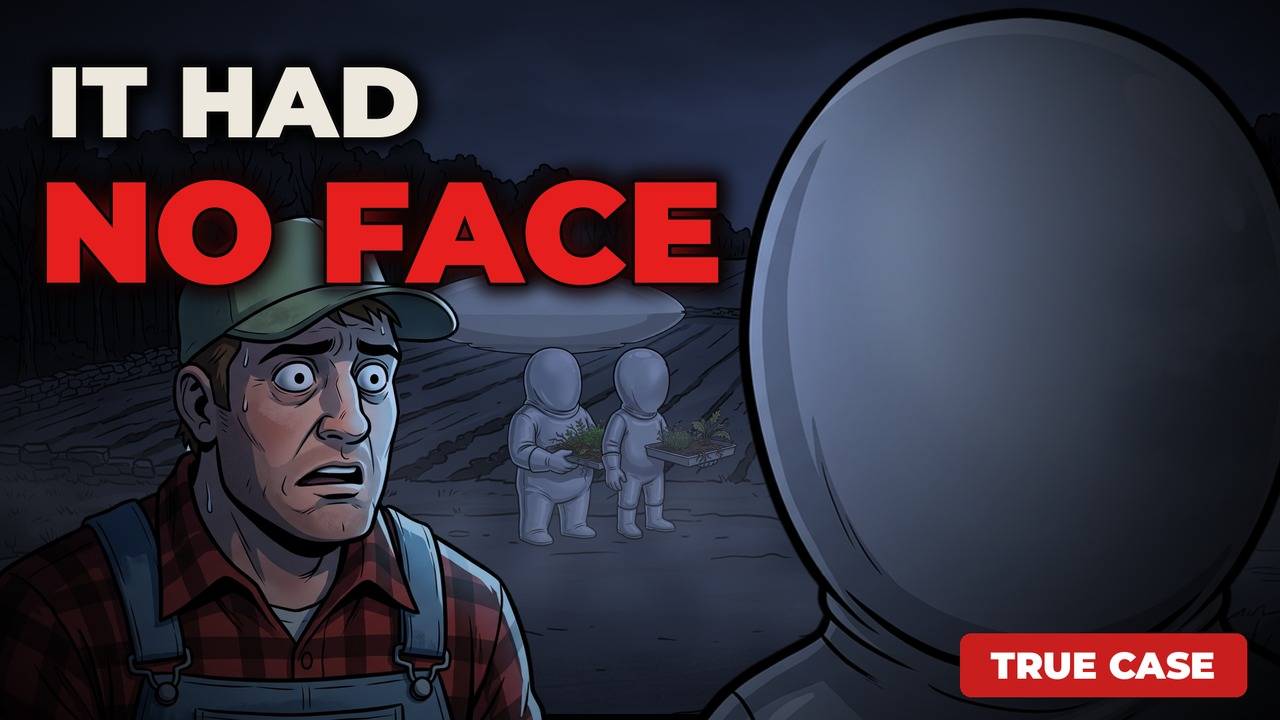
Two small figures with no faces stepped out from under a machine floating above a farmer's field. They were holding trays of soil and roots. And the first thing one of them said was: do not be alarmed, we have talked to people before.
Newark Valley, New York, 1964. Gary Wilcox, a dairy farmer with no time for jokes, said he talked with them for almost two hours, about manure, fertilizer and how things grow. They told him they came from Mars. That afternoon he left them a 75 pound bag of fertilizer under a tree. By morning it was gone. Years later the story grew a warning about astronauts who would die, and one of them died three years to the day after that morning. But the first newspapers don't mention any warning. This is the Wilcox case, told from the 1964 newspapers, the investigators and the psychiatrist who met him, with every answer the sceptics give.
This is a real case. What happened in the field is Gary Wilcox's own account. The astronaut warning appears only in accounts written after the deaths. Narration by an AI voice.
📚 Free horror book, The Kettleby Archive: The First Files: https://louloubooks.com/horror/free?ref=podcast
▶️ Watch the animated version on YouTube: WTF Scary Stories
Sources:
CUFOS HUMCAT index 1964, case 64-07 (Binghamton Press, NICAP reports, FSR 1969): https://cufos.org/PDFs/HUMCAT/HUMCAT_Index_1964.pdf
Chemung County Historical Society, local sightings (Elmira Star-Gazette, 8 May 1964): https://genealogylibraryelmira.wordpress.com/2021/03/15/a-timeline-of-local-ufo-sightings/
NICAP, occupant cases: https://www.nicap.org/occupants_hall.htm
The 1964 landing and Dr. Berthold Schwarz's visit (Brent Raynes): https://www.tall-white-aliens.com/the-1964-ufo-landing/
The Socorro case (Lonnie Zamora): https://en.wikipedia.org/wiki/Lonnie_Zamora_incident
© 2026 Lou Lou Press. All rights reserved.
Chapters
- Two figures with no faces
- Case file: Newark Valley, 1964
- Something flashed
- It wasn't a fuel tank
- He touched it
- Two figures came out
- Almost two hours of questions
- Mars, they said
- Voices that weren't voices
- They had to go
- The bag of fertilizer
- The sheriff and the newspapers
- The same day as Socorro
- The investigators
- The warning
- To the day
- What the first papers left out
- Four answers
- Afterwards
Read the story
Two small figures stepped out from under a machine that was floating above a farmer's field. They had no faces. They were holding trays of soil and roots. And the first thing one of them said to him was this. Do not be alarmed. We have talked to people before. Who had they talked to?
For almost two hours, they asked him questions. About his tractor. About manure. About how things grow. They told him where they came from. And he answered them, standing in his own field, while the thing they came in hung in the air beside him with nothing underneath it. That afternoon, he carried a seventy-five pound bag of fertilizer up the hill and left it under a tree, for them.
What happened to that bag by the next morning is the only part of this story that anyone else could have checked. Years later, the story grew a second part. A warning. A list of names. Men who were going to die. And one man on that list really did die, on a date that will make you look twice.
So when did that warning first appear? Before the deaths, or after them? Because the first newspapers to print this story are missing something. Case file. Newark Valley, New York. The spring of 1964. Newark Valley is a small farming town in Tioga County, in the hills of upstate New York, not far from Binghamton.
Dairy farms in the valleys. Thick woods on every ridge, right down to the edge of the fields. Gary Wilcox farmed about three hundred acres there. He was twenty-seven. Cows to milk twice a day, and fields that didn't spread themselves. Local accounts describe him as a serious man with no interest in publicity, and none in practical jokes.
So how does a man like that end up in the newspapers, talking about Mars? On the twenty-fourth of April, a Friday, a little after ten in the morning, he was on his tractor, spreading manure on a field that ran up to the edge of the woods. And at the top of the field, something flashed. A sharp, bright flash.
Like sun on metal, in a place where there shouldn't be any metal. He thought it was junk. A fuel tank somebody had dumped. Maybe part of a plane that had come down in the night. What else would shine up there? So he drove the tractor up the field to look. It wasn't a fuel tank. It was shaped like an egg, flattened.
About twenty feet long, fifteen feet wide, and only four feet high. Smooth and polished, the colour of aluminium. No rivets. No seams. No windows. No door. And it wasn't sitting on the ground. It was hanging in the air, just above the grass. He looked for whatever was holding it up.
There was nothing there. What would you have done? Run? Shouted for help? Gary Wilcox did what a farmer does with a thing he doesn't understand. He got down from the tractor, walked up to it, and touched it. Then he banged on it with his fist. Then he kicked it. Nothing. It didn't rock.
It didn't ring. It gave off no heat and no sound. Imagine your boot hitting metal that hangs in the air and won't even shudder. Then two figures came out from underneath it. He never saw a door open. They were simply there. About four feet tall. Thickset. Covered from head to foot in one shiny suit, white or silver, like metal cloth.
Their heads were covered too. He never saw an eye. He never saw a mouth. He never saw a face. So what was inside those suits? And each of them carried a tray. Square, metal, about a foot across. In the trays were alfalfa, roots, soil, leaves and twigs. As if they had been out gathering samples of the land.
He stood very still. For the first few minutes, he didn't say a word. He was frightened. He thought someone was playing a trick on him. Two little men in costumes, and a prop in the trees. It had to be. Then one of them spoke, and said the words you heard at the beginning. And what came next lasted almost two hours.
They asked what he was doing. They asked about the tractor, and the spreader, and the manure in it. Why did he use it? How did it work? They said they were interested in organic matter. He answered every question. And the whole time, he said, he felt he was being studied. Then he asked them where they came from.
Mars, they said. On Mars, they said, the ground was rocky, and very little grew. They wanted to know how people here did it, in the dirt. He asked if he could go with them. They said no. The air where they lived was much too thin for him. And they said they kept away from big cities, because of the fumes from cars.
Then there were the voices. Gary Wilcox said he understood every word. But he would not say it was English. And he said something that is still hard to picture. Their voices didn't sound like any voice he could describe. So what did they sound like? He never found the words. Let me ask you something.
If two figures with no faces walked out of the woods on your land and asked how you grow your food, what would you ask them back? Tell me in the comments. Because the one thing he asked for, to go with them, they refused. He offered them a bag of fertilizer from the barn. Would they wait while he fetched it?
No. They had to go. They turned, and went back under the craft, with their trays. The thing rose slowly. It made a sound, he said, like a car engine idling. It glided off over the field, and at about a hundred and fifty feet it shot away to the north. Within seconds, the sky was empty.
And what had it left behind? On the grass where it had hung, by one account, there was a small patch of something red. Like a red dust, or a jelly. And soon, that was gone too. He went back to the tractor. He finished the field. And that afternoon, he carried a seventy- five pound bag of fertilizer up to the top field, and left it under a small tree near where the thing had been.
In case they came back. The next morning, the bag was gone. Nobody saw who took it. And as far as anyone has recorded, nobody went up that hill to look. Who walks off with seventy-five pounds of fertilizer, from under a tree at the edge of the woods, in a single night? He reported all of it to the sheriff's office in Tioga County.
Within two weeks, it was in the papers. The Binghamton Press printed it on the seventh of May. The next day, the Elmira Star-Gazette ran it under a headline that asked if a farmer had met a spaceman. And answered: yes, says he, and they wanted fertilizer. People laughed. Of course they laughed.
But the people who knew him kept saying the same thing. Gary Wilcox wasn't a joker. Then why tell a story that would make him one? And there was something else about that Friday. Something he couldn't have known when he walked into the sheriff's office. The twenty-fourth of April, 1964, was the same day as Socorro.
That evening, at about a quarter to six, nearly two thousand miles away in New Mexico, a policeman named Lonnie Zamora was chasing a speeding car out of town when he heard a roar and saw a flame in the sky. He drove up into the desert to look. In a gully he found a white, egg-shaped object, standing on legs. And beside it, two small figures in white.
Two egg-shaped craft. Two small figures in white, each time. The same day, about ten hours apart, half a continent from each other. A coincidence? Or was something out there that day, in more than one place? The Socorro case went into the files of Project Blue Book, the Air Force's own investigation, as one of the cases they never explained.
The Wilcox case barely left the county. But some people did come. A planetarium lecturer from Boston, Walter Webb, looked into it for NICAP, the biggest civilian UFO group in America. And in October 1968, a psychiatrist from New Jersey, Dr. Berthold Schwarz, drove up to the farm and sat with Gary Wilcox in his home.
What does a psychiatrist look for in a man who says he talked with Martians? Signs of a liar. A dreamer. A man who wants to be famous. Schwarz came away impressed. He wrote that he was struck by Wilcox's honesty, his intelligence and his stability. His report was published in 1969.
And by then, the story had a part the newspapers of 1964 never printed. The two figures, those later accounts say, had told him something else in the field. Four astronauts would die. Two Americans, John Glenn and Gus Grissom. And two Russians. Within a year. From exposure to the elements of space.
A year went by. None of those men died. So why does anyone still talk about that warning? Then, on the twenty-seventh of January, 1967, a fire broke out inside the Apollo 1 capsule, during a test on the launch pad in Florida. Gus Grissom died inside it, with two other astronauts.
Three months later, the Russian cosmonaut Vladimir Komarov came home from space in Soyuz 1. His parachute didn't open. He was killed when the capsule hit the ground. He died on the twenty-fourth of April, 1967. The twenty-fourth of April. Three years to the day after two figures with no faces stood in Gary Wilcox's field.
And John Glenn? He lived. He went back into space at seventy-seven, and he died in 2016, at ninety-five. So the warning was wrong about the year. Wrong about Glenn. Wrong about a second Russian. And strangely right about Grissom, and about that date. But here is what you need to know before you decide what that means.
The newspaper reports from May 1964 that I've been able to find talk about Mars, and manure, and fertilizer. Not one word about astronauts. In every account I've found, the names only appear after the deaths had already happened. Does that prove he never said it? No. Reporters leave things out.
And a man who had already been laughed at for meeting Martians might keep the strangest part to himself. But it means nobody can show that the warning came first. Which leaves the question this whole case turns on. What was really standing in that field? There are four answers worth taking seriously.
Each one explains part of that morning. Watch for what each one leaves behind. The first is a prank. That's what he thought himself, for the first few minutes. Two short men in costume, and some kind of prop. But a prank that holds a farmer in his field for two hours, talking about manure, and never once lets him see a face?
A prank with no laughing neighbours, and nobody confessing, in sixty years? And where is the prop? Something twenty feet long that floats without a sound, then shoots into the sky. The second is that it happened inside his head. A vivid waking dream, out on a tractor in the spring sun.
A few people do have experiences like that, and they feel completely real. But Berthold Schwarz was a psychiatrist. That is exactly the kind of thing he was trained to notice. And he came away impressed. And can a dream carry a seventy-five pound bag of fertilizer away in the night?
The third is a story shaped by its time. In the fifties and early sixties, a whole movement of people in America said they had met kind visitors from Mars and Venus, who came with warnings for humanity. Gary Wilcox's Martians sound a lot like them. Was he telling their story, in his own field?
Then, in July 1965, the Mariner 4 probe flew past Mars and sent back the first close pictures. A dead, cratered world. Rocky ground, just as they had said. And no one down there at all. The fourth is that it happened the way he told it. That something came down in that field and took samples, and that whatever was inside those suits told him a story he could understand.
Mars, because Mars was what a man in 1964 would understand. The investigators who met him believed he was telling the truth as he knew it. One case index rates his credibility as very high. But if that's the answer, the question gets worse, not better. Who were they? And who had they talked to, before him?
Gary Wilcox went back to his cows. He was offered large sums of money for the rights to his story, and he turned them down. Why would a man trying to fool people turn down money? He said that if it ever happened again, he would do the same thing. People who came looking for him found a farmer who would answer their questions, then go back to work.
The hills above Newark Valley are still farm country. The woods still come right down to the edge of the fields. If your family is from Newark Valley, or anywhere in Tioga County, and someone once told you what happened to that bag, I would very much like to know. Write it in the comments.
The free files from the archive are in the description. And if you'd like to be here when the next case file opens, subscribe. Because somewhere in those hills, on an April night in 1964, a seventy-five pound bag of fertilizer sat under a tree, waiting for visitors who hadn't stayed for it. By morning, it was gone.
So who came back for it?
This story is fiction: names, places and events are invented.
A free book
Listened to the cases? These are the files the archive couldn't verify: eight of them, free, one never told anywhere else.
Open the files →The horror books
Alice Kettleby's books, sold directly by the press that publishes them.
Browse →More episodes
44. The Policeman Who Lost Fifteen Minutes: The Todmorden Case (Real Case)43. 3 Real Alien Abductions: Allagash, Mojave and Kelly Cahill (True Cases)42. Her Dog Knew Something Was in the Yard: The Copley Woods Case (Real Case)41. It Came Through the Closed Door: The Andreasson Affair (Real Case)The Kettleby Archive: The First Files. Eight files as a PDF and EPUB, one never told anywhere else. The link comes by email.